

Book
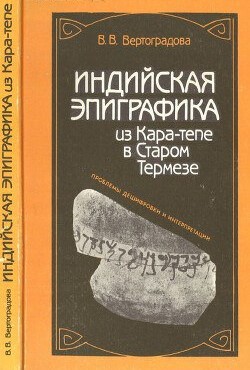

Indian Epigraphy from Kapa-Tepe in Old Termez: Problems of Decipherment and Interpretation
Москва, 1995, 160 p.
The book ’lndian epigraphical finds from Кага-tepe in Old Termez’ by Victoria Vertogradova is a study and a publication of ali Indian inscriptions (in both Kharoshthi and Brahmi scripts) encountered during the archaeological investigation at the Кага-tepe mound in Old Termez (the excavations of B.Ya.Staviski).
The excavations at Кага-tepe have not yet been completed.
However, at present there is a considerable number of Indian inscriptions (more than 200 items). Those have to be interpreted in the context of other sites of Central Asia and India and the new problems have to be raised.
The methods used were based on the study of the structure of epigraphic texts and the establishment of their ”genre” characteristics. It gave us a clue to the deciphering and reconstrution of many a fragmentary inscription and enabled us to trace approximately the limits of their use for the source study purposes.
The book comprises three parts and an appendix.
The first part deals with the study of the principles of composition of an epigraphic text. The problems of genre, text transformation, correlation between genre and script, between script and language are thoroughly examined. Indian inscriptions are compared with those in ’unknown lettering’. The palaeography of the inscriptions and their dating are investigated.
The latest finds of brahmi inscriptions allowed the present author to datē the decline of the monastery to the late 5th-early 6th centuries A.D. To establish the typological traits of brief and poorely preserved wall inscriptions one has to investigate the correlation between the text and the painting. In many cases it allows us if not to read the inscription, at least to establish its genre and to compare it with its Indian counterparts.
The second part of the book deals with the investigation of the possibilities that Indian inscriptions provide for the study of the Buddhism and of the functioning of a Buddhist community at Кага-tepe. The problem of Buddhist schools having propagated their teaching in Termez is raised. For instanse, the relations of these schools with Indian Buddhist centres, particularly with those of Central India and Eastern Deccan in the later period of existence of
the monastery can be traced. The problem of the viharas of Кага-tepe is specially investigated. The name of the Кага-tepe monastery (’The Ruler’s vihara’) is established. Admittedly, a local ruler or governor founded the monastery on the Southern hillock of Kara-tepe.
The occurence of the name of ’the vihara of Gondofar’s son’ in a recently discovered inscriptions raises a whole cluster of problems related to the name and the datē of foundation of the monastery.
The third part of the book is a publication of the whole corpus of the inscriptions of Кага-tepe (both Indian ones and those in ’unknown lettering’) encountered from 1961 up to the fieldworks carried out in 1989 In this part the inscriptions previously published by T.V.Grek and the present author are revised with due regard to the criticism and observations of J.Harmatta, O. von Hiniiber et al. The inscriptions are classified according to the materiāls they were written on (inscriptions on pottery, wall inscriptions) and to their script (Brahmi, Kharoshthi).
In the appendix ali Indian inscriptions from the adjacent monastery of Fayaz-tepe published by M.I.Vorobyova-Desyatovskaya are revisited.
In many cases their reading and interpretation can be defined more accurately in the light of the Kara-tepe data.
In the same part ali the inscriptions in ’unknown lettering’ from Central Asia discovered by now are published. Those are compared with the inscriptions in this lettering from Кага-tepe published in the third part of the present book.
Problems related to the study of ’unknovm lettering’ and its correlation with Indian script are investigated as well.
The book is supplied with an album containing 112 lists of illustrations.